
The 5 Identity Shift That Makes Healthy Habits Easier
Stop and think about it.
You’ve tried the meal plan. You’ve tried the gym schedule. You’ve tried the “no phone after 9pm” rule. And every single time, it works for a week, maybe two—and then you’re right back where you started.
That’s not because you’re not trying. It’s because you’ve been trying to change your actions without ever changing who you believe you are. And today I’m going to show you the exact shift that fixes that.
Because by the end of this article you’ll have a completely different way of thinking about every habit you’ve ever struggled with and you will understand the 5 identity shift that makes healthy habits easier.
Table of Contents

Every Action Is a Vote for Your Identity
Here’s the thing nobody tells you about habits: every action you take is a vote for the type of person you believe yourself to be.
If you think of yourself as “someone trying to eat healthy,” every salad you try to eat is going a fight against your real identity and who you currently believe you are. So You’re going to be constantly swimming upstream making no real progress. But if you start to think of yourself as “a healthy person,” eating the salad isn’t going to be a fight it’s just going to be what you do. And it’s just going to a confirmation of who you already are.
That’s the identity shift. And once you make it, habits stop feeling like willpower battles and start feeling like alignment.
This isn’t just motivational talk. Research in behavioral psychology suggests that habits become more automatic when they are repeatedly tied to consistent cues and personal identity. Studies published through the U.S. National Institutes of Health have shown that habits are strengthened through repetition until they become increasingly automatic behaviors.
And honestly, it’s rooted even in something even older. Proverbs 23:7 says, “As a man thinks in his heart, so is he.” That’s the identity shift in a single verse thousands of years before modern psychology caught up to it.
So I’m going to break down exactly why it works, and exactly how to do it yourself.
Why Most Habit Advice Fails?
Let’s start with why the typical approach to habits sets you up to fail in the first place.
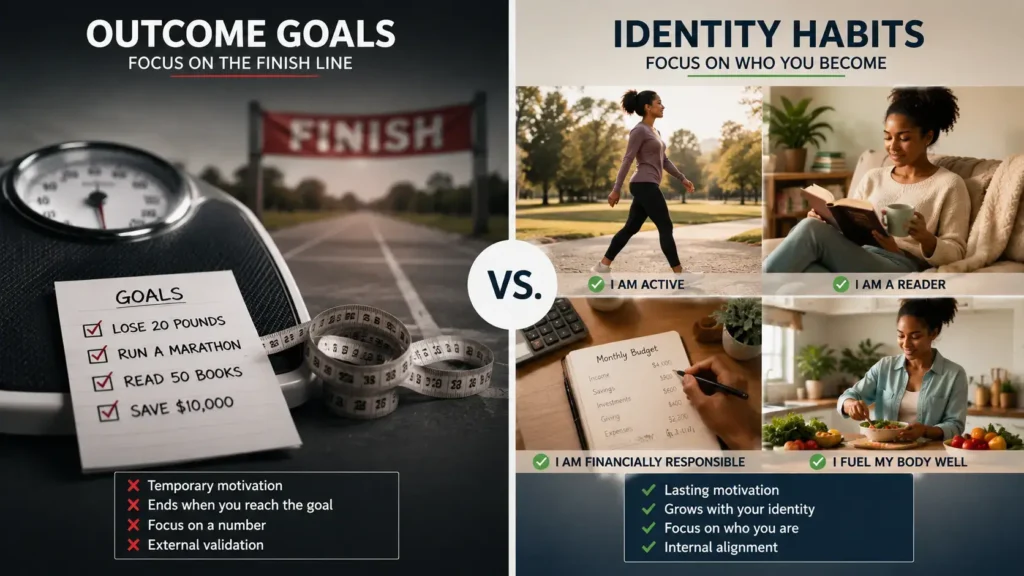
Most habit advice focuses on outcomes.
- Lose 20 pounds.
- Run a marathon.
- Read 50 books this year.
These are what psychologists call outcome-based goals. and they have a hidden problem with them.
The thing is once you hit these goals, the motivation that drove you disappears. You lost the 20 pounds now what? And if you fail to hit them, the motivation also disappears, and goes in the opposite direction where you now feel like a failure and quit. Either way, the goal was never connected to you. It was just a number you were chasing, completely separate from your sense of self.
Compare that to identity-based habits. For example Instead of “I want to lose weight,” it becomes “I am someone who moves their body every day.” Another example is Instead of “I want to read more,” it’s “I am a reader.” Another one can be Instead of “I want to save money,” it’s “I am someone who’s financially responsible.” So it’s all about reframing and identity shifting
See the difference? One is a task on a to-do list something external, something you can check off and walk away from. The other is a description of a person something internal, something that becomes part of how you see yourself.
And here’s the key insight: people will abandon to-do list items easily, and also let them slide. But what people very rarely do is abandon who they believe they are. We defend our identity, often without even realizing we’re doing it.
This is actually why so many people who lose weight gain it back. They changed their actions to hit a number, but they never changed their identity. Deep down, they still saw themselves as “someone who struggles with their weight” who was temporarily doing something different. The moment the structure disappeared, they reverted to the identity that was still running the show underneath.
How the Shift Actually Works?
The 5 Identity Shift That Makes Healthy Habits Easier
So how do you actually make this shift instead of just repeating affirmations in the mirror and hoping something changes?
How you do this is:
1. Decide the Identity before the Behavior
This is the part most people get backwards. They think, “Once I’ve worked out consistently for a few months, then I’ll start calling myself a runner or someone who’s fit.” But that’s exactly backwards. You don’t wait until you’ve run 100 miles to call yourself a runner. Decide you’re a runner first, then let your actions catch up to that belief. I call this Identity follows functionality. So every small workout becomes proof of who you already are, instead of a means to becoming someone else someday.
Hence this idea of identity preceding behavior actually shows up throughout Scripture too. 2 Corinthians 5:17 says, “If anyone is in Christ, he is a new creation; the old has gone, the new is here.” Notice it doesn’t say “he is becoming a new creation” it’s already done. The identity comes first, and the new way of living flows out of it.
2. Use Small Wins as Evidence, Not as the Goal.
So Each time you do the habit, ask yourself a simple question: “What does this say about the kind of person I am?” Drinking the One glass of water instead of soda isn’t just hydration it’s a vote for “I’m someone who takes care of their body.” One workout, even a short one, is a vote for “I’m an active person.” Stack enough of these small votes and the identity becomes undeniable, to you. This is sometimes called the “evidence-based identity” approach you’re essentially building a court case for who you are, one small action at a time.
3. Let our Environment reflect the Identity.
Research consistently shows that environmental cues strongly influence behavior and habit formation.
A “healthy person” doesn’t keep junk food on the counter and chips by the bed within arm’s reach . A “reader” doesn’t have their bookshelf buried in a closet while the TV remote sits on the coffee table.
So change your surroundings to match who you’re becoming and being, and the friction practically disappears on its own. You won’t need willpower to avoid the cookies if the cookies were never bought in the first place.
Your environment should look like the home of the person you’re trying to become and be not the person you’re trying to leave behind.
Therefore it’s about creating an environment that makes your desired identity easier to live out.
Watch Video
4. Speak about Yourself in the present tense.
Stop saying “I’m trying to” and start saying “I am.” This sounds small, almost too simple to matter, but the language you use about yourself is constantly shaping your internal narrative. “I’m trying to eat healthy” leaves the door wide open for failure trying implies you might not succeed. “I am a healthy eater” closes that door. It’s a statement of fact about who you are, not a hopeful attempt. So Pay attention this week to how often you use language that distances you from the identity you want, and start correcting it in real time.
5. Surround yourself with People who Reflect the Identity.
This one doesn’t get talked about enough. We are deeply influenced by the identities of the people around us. If everyone in your life sees themselves as someone who doesn’t exercise, doesn’t read, doesn’t save money it becomes much harder to hold a different identity for yourself. You don’t need to cut people off, but seeking out even one community, online or in person, of people who already live the identity you want can dramatically speed up the shift. Their normal becomes your normal.
Even Proverbs 13:20 points to this: It says” Whoever walks with the wise becomes wise, but the companion of fools suffers harm.” The identities around you shape the identity within you, whether you notice it happening or not.
Why This Makes Habits Easier?

Here’s the part that changes everything: when a habit is tied to identity, you stop needing motivation.
Motivation is a feeling and feelings are unreliable. Feelings come and go and they’re influenced by:
- Not enough Sleep
- Stress
- Your Mood
- The Weather
- What happened at work that day
- Energy levels
- Life circumstances
Therefore if your habits depend on motivation, they’re being built on a foundation that shifts every single day. That’s why “motivation-based” habits are so fragile.
Identity based habits, on the other hand don’t evaporate just because you had a bad night’s sleep. You don’t need to “feel like” going to the gym when going to the gym is just what a healthy person does — it’s not a decision you have to make from scratch every morning. There’s no internal hard negotiation. No decision fatigue. No bargaining with yourself about whether today is the day you’ll finally stick to the plan.
This aligns with principles found in Self-Determination Theory, a well-established psychological framework that explains how lasting behavior change is more likely when actions align with deeply held values and identity.
Think about brushing your teeth. You don’t wake up and debate whether you feel motivated to brush your teeth. You just do it, because somewhere along the way, “a person who brushes their teeth” became part of your identity.
That’s the exact same mechanism you will have to try to build for whether exercise, eating well, reading, saving money, or whatever habit you’re working on. The goal isn’t to find more willpower. The goal is to make the habit as automatic and identity-driven as brushing your teeth.
That’s the real unlock. Not more discipline. Not more willpower. A new self-image that makes the old behavior feel foreign and the new behavior feel like home.
And I want to be honest with you: this shift doesn’t happen overnight. It happens through repetition, through those small daily votes we talked about earlier. But the compounding effect is real. Each vote makes the next one easier, because you’re not fighting your self-image anymore you’re confirming it.
Final Thought
Because I want this to actually stick with you.
And I really want you to actually do this, not just nod along. I want you to Pick one habit you’ve been struggling with, and rewrite it as an identity statement. Don’t write “I want to eat healthier” if that is the goal write instead “I am someone who fuels their body well.” If the goal is to exercise more” instead write “I am an active person.” Write it down somewhere you’ll see it every day. And the next time you take even the smallest action in that direction, pause for a second and let yourself recognize it: and know that was a vote for the person you’re becoming.
Do those things consistently, and the habits you’ve been struggling with for years will start to feel less like a fight and more like just… who you are.
And if you take nothing else from this article, take this: Ephesians 2:10 says you are God’s “workmanship, created for good works, which he prepared beforehand.” So you’re not starting from scratch trying to become someone new. You’re stepping into who you were already made to be. The habit isn’t creating your identity it’s just finally catching up to it.
If you found this article to helpful in helping you shift how you think about habits, leave a comment below and tell me: what’s the identity you’re trying to become?
Thanks for being here and reading this.

Patricia Patterson is a lifestyle strategist helping women build discipline lives rooted in God in their faith, lifestyle, wellness and finance. Through Flamboyannt Wellness, she shares, wellness and lifestyle guidance and tools to help women and individuals navigate aging well with strength and vitality.